
COP26: smokes and mirrors
Summits of ambitions and commitments
Around 20,000 government representatives, scientists, policy experts, celebrities, influencers, and activists are convening this week in Glasgow, Scotland, for COP26, the UN Climate Summit commencing Monday.
Yet I cannot help but feel a sense of frustration in regards to the vast discrepancy between the amount of hype that the event has been receiving and will continue to—relative to the actual impact such conferences, led by the world’s political elites, have actually had in the past decades.
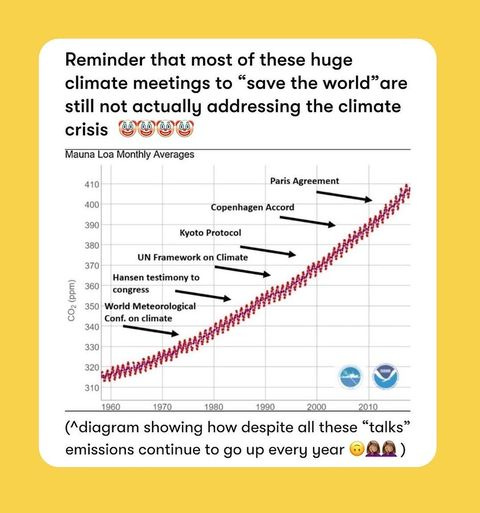
“Aspiration and ambition are cheap, and these are the goods that have been bought and sold at COP21.”
Let's start with The Paris Agreement from COP21 in 2015, which was viewed by many within the environmental movement as a great success—a “turning point”.
But in reality, to not simply regurgitate the reporting from mainstream media and to look honestly at what it really accomplished, one could say it was more of a “Summit of Ambition.”
“The Paris Agreement taught us that ‘ratcheting’ was the de rigueur method of manifesting [its] ambition…
[But] we discover that in the end, the much-heralded ‘ratcheting’ process includes reporting and review, reporting and review in slightly different words, and ‘strengthening of commitments.’ I think that we can, with complete confidence, believe that as a result of this agreement, a lot of reports will be written.
On the other hand, there are no mechanisms to enforce the commitments.” –John P. Clark via Between Earth and Empire.
While many looked to the Obama administration, then, as a progressive climate leader, it actually was one of the main reasons there were no mechanisms of enforcement included.
“The tactic that the Obama administration planned to use to ‘outsmart’ the Republicans was simply to give up on anything that the Republicans would object to very strongly. In short, if the Paris Agreement contained nothing that was of real consequence or was binding, there would be nothing for the Republican Congress to veto…
As the article recounts, ‘under U.S. insistence’, the Paris Agreement ‘was explicitly crafted’ to exclude: 1) any binding agreement to emissions reductions; 2) any binding agreement to financing of emissions reductions; 3) any binding agreement to fines or penalties of any kind for failure to reduce emissions.
Only one thing was agreed to legally: written reports every five years…
COP21 perpetuates the tendency—rampant among environmentalists and the politicians who want to appease them—to substitute spectacle for substantive action.
They continue to put far too much effort into the politics of the gesture and far too little into massive direct action on behalf of a rapid end to carbon emissions.” –John P. Clark via Between Earth and Empire.
As reported in 2019, only two countries were on track to meet their voluntarily set climate pledges. As if that weren't disheartening enough, recent reports show that only one country, The Gambia, is aligned with Paris Agreement targets.
So the Paris Agreement, again, touted, unquestioned by most, as some great achievement, really was viewed as pivotal only because many countries came together and agreed that the climate crisis was important and that commitments needed to be made.
In the end, subpar goals were set; most of them were unmet.
Greening extraction—justified by scientific framings of climate change
As President Biden and other U.S. government officials prepared to show up at COP26, they made concerted efforts to solidify some sort of a plan to save face and to showcase their leadership.
“More than $500 billion of an emerging Democratic spending plan is targeted to fight climate change, making it one of the biggest portions of a bill likely to top $1.5 trillion…
While details are still being worked out, the framework is expected to include expanded tax credits for renewable power, advanced energy manufacturing and electric vehicles, as well as incentives to support investments in electric transmission, energy storage, and sustainable aviation fuel.” (Source.)
It's important to note that the latest iterations of the bill have already been diluted compared to the original proposals for climate action. And Sunrise Movement's youth activists took note, initiating a hunger strike in front of the White House just a week ago in protest of the compromises made.
Nevertheless, representatives of the U.S. at least get to attend with some things to say about what they intend to do. And for many, these “little wins” are enough to reason the significance of these Conferences of the Parties.
But it's worth asking: Can a crisis of over-extraction and the erosion of place-based relationships be solved by spending more money to expand extraction—just in alternate forms?
As it stands, the “bold” climate action being celebrated looks like historic levels of investments for “renewable” energy, “advanced” energy manufacturing, electric vehicles, more electrification-related progress, and so forth. And this is not a surprise, as scientists, propped up as the most important voices in the discourses on climate change, largely have been framing it as an issue of excess carbon and greenhouse gas emissions.
But this sort of emphasis allows for “net-zero” solutions that reduce Earth’s fever and historic traumas into a simple balancing equation of emissions and sequestration. As a result, the byproducts of lowering emissions at all costs—such as blowing up entire landscapes for open-pit mining, clogging up more of Earth's veins that nourish vast ecosystems with dams for hydropower, displacing local and Indigenous communities for “nature-based” carbon drawdown—end up downplayed, justified, or dismissed.
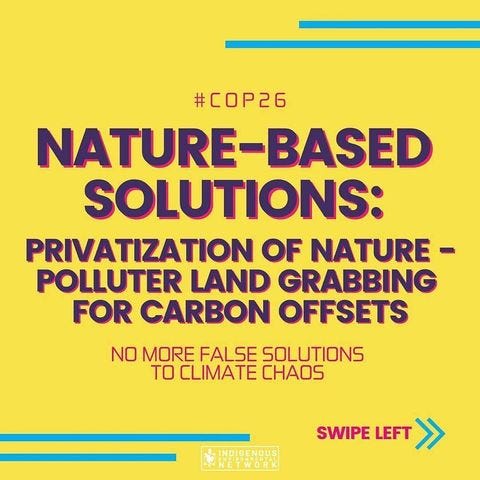
A narrow focus on the chemistry of carbon emissions leads to narrow-minded solutions that might solve one part of the equation—while just creating more problems.
Stronger commitments to… faux solutions
What I'm trying to get at is this: The repeated COPs have largely been about strengthening (failed) commitments. And even as more “ambitious” solution pathways are proposed and implemented, they are surface level and off base.
Instead of just tossing more money at the crisis to expand extraction, where are the plans to end the spending on things that have been hugely destructive—like militarism and wars, societal “development” that further disconnects people and their lifeways from place-based ecological systems, or financial advantages given to Big Ag, Big Oil, Big Pharma, Big Finance, etc.?
And where are the discussions on halting global imperialism and predatory trade deals that lead to the absurd shipping back-and-forth of the same foods and products—at the expense of community sovereignty everywhere and at the benefit of corporate giants and the political elites?
“We're seeing that the process of trade treaties, in the name of avoiding wars and depressions, was actually handing more power to global corporations and banks.
We're seeing that the entire environmental movement, particularly the climate movement, has served to centralize corporate power and profit even more.
And we're seeing how the UN, as a structure, has ended up servicing this process of centralizing economic power.” –Helena Norberg-Hodge via Local Futures.
When I wrote about how the plastic-free movement misses the mark a few months ago, some responded to my call for going beyond lifestyle choices, saying, “Yes, we need extended producer responsibility!”
That, too, but my point was actually much deeper than that—pertaining to how we’ve created a globalized system which has made many formerly food-sovereign communities now reliant on mass-produced, unhealthy, packaged foods and other goods imported from far away.
Likewise, my point was also an invitation to question why subsistence communities, previously able to feed themselves well with fresh, nutritious, bioculturally relevant foods, have been systematically pushed to abandon their local foodways and ecological knowledge—in order to grow monocultures of “productive” crops for export.
“[Getting to live in Ladakh, an Indigenous, subsistence-based community], I came to see that the dominant economic system brought a multitude of systemic problems. I saw it there in a very clear way, where advertising, schooling, etc. glamorized an urban consumer culture and made people feel so stupid and backward if they lived close to the land…
The whole system, by subsidizing in the modern era, subsidizing global trade, destroyed the local economy and created this ever increasing dependance on transported goods—especially food.
Suddenly, butter arriving in the local market, having been transported for a week over the Himalayas, sold for half the price of butter from the farm down the road.
Then of course, air pollution, plastic packaging, refrigeration, all started having huge impacts on the environment. And I saw that suddenly, people pushed into the city were looking for artificially scarce employment that had never existed before. There was plenty of work to do to provide for food, clothing, or shelter, but there had never been such a thing as unemployment. But fighting for scarce jobs led to local friction and divisiveness.
The breakdown of the connections to nature and the connections to each other led to a deep spiritual crisis.” –Helena Norberg-Hodge via Green Dreamer EP165.
Decentralizing power, rebuilding community
If we re-established place-based systems everywhere—at least for our most basic needs like food—it literally would lead to a mass, global “decarbonization”. It also would help to rebuild communities and networks of care, while humanizing all aspects of life and labor.
Yet these sorts of transformative visions are never on the table. It's no surprise, given that these changes would require breaking down monopolies, giving back resources, and democratizing power back into the hands of communities.
This is precisely why such conventions, led by the global technocratic class and the political elites of nation-states, will never lead us to the systemic changes we need—because such proposals would undermine their power and the existing systems propping them up.
In the end, their seemingly progressive, proposed spendings to address ecological breakdown end up being technology-centric—because incremental substitutions allow the political and corporate powers, in bed with one another, to continue to centralize control.
“What we're doing with decarbonization pathways is planning and aligning all the economies. This is not for the sake of people or environment. It’s for the sake of having predictable environments and forecasted scenarios for profit and for corporations. You're taking the power of nation-states, as complicated and diverse as they are, to create a platform for corporations to rule.
This is the structural process. We need to really see the climate negotiations, as naked as they are, for putting forward this agenda.” –Dr. Camila Moreno via Local Futures.
A multilateral front masking injustice
Many argue that these global conferences are critical because they are the only place where international collaboration on climate action can be discussed—a convening where “everyone” across the globe has a seat at the table.
Not only does this minimize the importance of global solidarity among people's movements that have been collaborating across borders year-round, but the purported “inclusivity” of the event has been a guise for deeper injustices.
“Very few countries actually can pay to have a body of diplomats, trained in a perfect understanding of English, [to attend]. There are only translations to the five official UN languages. All of the negotiations and the drafting happen in English. So if you're not a native speaker, you're already behind.
Then, imagine all the African countries and small island states. They don't have the money to fly in to then pay for hotels, overpriced food, etc.
All of these things add up to create a context where people think there is a multilateral thing going on. But actually, very few people who’ve been running the show for a while, sometimes staying in the shadows, are the ones proposing and summarizing the drafts.”
Not to mention, the few government officials able to attend from “developing” countries are typically among their elites—many of whom are influenced by mega-corporations seeking to pry open and infiltrate their local markets.
They do not speak for the most marginalized communities within their borders, who have been facing injustices perpetrated by their own governments.
The Indigenous Sengwer people of Kenya, for example, are facing displacement, militarily forced by their own state—supposedly for “carbon sequestration” purposes taking advantage of the healthy forests they’ve stewarded for millennia. The Maasai people are also being pushed off their Indigenous lands in the name of “conservation” (based on a plan by UNESCO and the Tanzanian government).
The difficult reality is that there are many well-intentioned activists attending COP26 from the Global North who are enthusiastically cheering on the co-opted “green” agendas that help further centralize power—a path “forward” that will continue to disenfranchise the communities, disproportionately in the Global South, who are defending their lands, place-based systems, and biocultural knowledges from the forces of economic globalization.
This kind of contradicting advocacy for “climate justice” (as represented by Al Gore’s vision and those who prop him up as a climate hero)—calling for a “systemic” change through both providing reparations for historically harmed communities while merely swapping fossil fuels with “clean” energy—end up helping to mask and even fuel the acceleration of global injustice.
“What's happened in the North is the green movement has adopted a platform that's based on Thomas Friedman's ideas of structural adjustment in the U.S.—without fundamentally changing the imperialist nature of this country.
At the expense of who? Native peoples, for sure.
If we look at Biden's Renewable Energy Transition Plan, he wants to electrify the federal fleet, which I think is a noble endeavor. But at the same time, what are those components for the rechargeable batteries for these vehicles going to come from? They have to come from somewhere.
The copper wiring that they use in renewable technologies, at this point in time, cannot be recycled copper—it has to be from iron ore. It has to be mined out of the Earth. Where is the United States going to get this copper ore?
One place that three administrations have targeted—the Obama, Trump, and now Biden administrations—is somewhere called Oak Flat, which is a sacred site to the San Carlos Apache Nation.” –Nick Estes via Green Dreamer EP328.
#ProtectThackerPass, a movement to protect the ancestral lands of the Paiute and Shoshone peoples from lithium mining, is another point of contention showcasing the impossibility of “a just transition” through mass expansions of any sort of technology-centric solution.
And such conflicts are a lot more prevalent in the Global South—though much less reported about. Across East Africa, Southeast Asia, and especially Central and South America, local and Indigenous peoples are facing serious human rights abuses from “renewable” energy projects—including “dispossession of their lands, livelihoods undermined, threats and intimidation, killings, displacement, among other abuses.”
The “green” movement needs to hold up a mirror in front of ourselves, as the same destructions caused by the endless extraction of fossil fuels are being replicated right now in the name of “climate justice”.
If this sort of transition—fixated on reducing greenhouse gas emissions at the cost of literally anything—were the movement’s idea of “just”, count me out.
The People's Agreement of Cochabamba
If there is one global meeting to take inspiration from in regards to setting a collective, Earth-centered agenda, it would have to be the “World People’s Conference on Climate Change and the Rights of Mother Earth”, which took place in April 2010 in Cochabamba, Bolivia.
Over 30,000 people from 100+ countries (primarily those of the “Global South”)—including 40 government officials and thousands of activists, Indigenous leaders, and representatives of social movements—joined forces and collaboratively wrote a declaration entitled “People's Agreement”.
That most environmental activists of the Global North know of COP21, for example, but not the People's Agreement should speak volumes. I strongly recommend all those planning to engage with COP26 read the People's Agreement in its totality.
Notably, it is clear-eyed about the endless-growth-reliant system being at the heart of ecological breakdown; it recognizes the traumas from the legacy of colonization and imperialism; it calls for an end to all forms of exploitative power dynamics; it has little to no mention of “clean” energy or technofixes as the solution; and it is oriented towards healing relationships and re-establishing life-affirming values.
I'll let the document speak for itself—you can find it here.
Eyes on the peripheries and underground
For all of the reasons stated above, I do not give COP26 much weight for being able to spark meaningful, structural changes. I do not view it as a “significant” event just because it's “being billed by many as the last chance for governments to commit to significant enough changes to stay within the 1.5C limit.” After all, history has shown that past climate “commitments” have almost never been met.
Plus, I recognize that the systemic transformations we need—requiring a decentralization of control and rebuilding of grassroots power—will not happen at the site where the global powers and political elites cordially convene. It is just not a path forward that would be in their interest to entertain.
Instead, in regards to COP26, I'll be looking to the peripheral, disruptive happenings and direct actions led by everyday people and workers, and I'll be supporting those hijacking the heightened publicity for pertinent community-centered initiatives. I honor the activists who are attending with strategic purposes, and I genuinely hope they can get out of it what they intended to.
Otherwise, as I'm interested in examining everything through the lens of power, questions I continue to ask include:
REBUILD - How are communities rebuilding resilience to reclaim their power—and to render their reliance on the exploitative, centralized system obsolete?
DISRUPT - How are workers and everyday peoples uniting in their resistance struggles to disrupt the status quo?
DISMANTLE - What are various people’s movements doing at the actual sites of tension to challenge existing power structures to gain leverage?
“When people can come together to create the safety net of developing and diversifying their local economies to provide for their own needs—accompanied by strong, big-picture activism—you begin to create a strength that can withstand manipulations and to bring down the threat of the corporate empire.” –Helena Norberg Hodge via Local Futures.
A lot of such efforts aren't and will not be reported much on—and this may be why so many view rejections of the importance of COP26 as a message to then just give up. That is certainly not my message. And it's evident that the dominant media sphere and educational system have stunted our imaginations in regards to our possibilities.
Many of the union-led strikes happening right now, winning the outcomes of better pay or working conditions they set out to achieve, are barely getting any news coverage. A lot of the most confrontational efforts halting extraction aren't being acknowledged. And the majority of those who have been working to materialize alternate futures through localizing systems, rebuilding networks of care, and revitalizing bioregional cultures and lifeways, are going unrecognized.
But such reclamations of grassroots power are my main sources of inspiration. Because talk is cheap.
And I truly believe we can much more effectively compost the current system by noticing where and how structural power has and is being shifted, transformed, dismantled, and reclaimed—and digging our hands in to feed and nourish those already germinating and groundbreaking seedlings.
Related resources:
COP, carbon, and high-tech: who is setting the agenda? Ft. Dr. Camila Moreno.
“A climate rally scheduled for Saturday, Nov. 6 is expected to draw as many as 150,000 people. More than 10,000 police officers will be deployed of the course of the 13-day conference from across Scotland and the United Kingdom.” (source)
The Wayúu Indigenous people of northern Colombia and Venezuela have been dealing with their ancestral lands being affected by the wind energy boom taking advantage of their geography. Learn more here.
Helena Norberg-Hodge on localizing economies, via Green Dreamer
Nick Estes on decolonial histories and futures, via Green Dreamer
Kristina Lyons on soil as cultural, relational, historical, via Green Dreamer
John P. Park on a world beyond domination, via Green Dreamer
Other recommendations:
To Catch The Sun is a new book, free to download (or available for sale in bookstores), on “inspiring stories of communities coming together to harness their own solar energy, and how you can do it too!” It is co-written by Lonny Grafman, who I interviewed for Green Dreamer a while ago on decentralizing systems for resilience.


I really appreciate your voice, Kamea. Keep writing, please.
Beautifully said and much appreciated. Community and place-based change is so important, and I wonder how people can better develop a sense of being a part of, or responsible to, communities in order to see them as sites for change to start.