They say we live in a simulation. I say 2D doesn't exist.
May we go touch grass and learn their names.

Do you remember first learning in math class about the dimensions — one dimension being a line, two being a plane, and three being spatial?
I never thought I’d have anything to say about that.
But as I’ve been fed all these videos about how we’re living in a simulation while I’ve been working on my manuscript — in part exploring how we know what we know — what appeared to be this basic thing that I’d accepted long ago came back to me.
In one of the videos I watched, the presenter began by first going through these seemingly unquestioned explanations of the dimensions — and how each dimension is unable to see what’s above it.
As he started drawing lines on a piece of paper to demonstrate what 1D and 2D were, I realized that I had an objection.
The square he had drawn on the paper was merely a representation of a two-dimensional plane. But the paper itself had depth and texture. The graphite left behind by the pencil also had depth.
Where can I go to find “Flatland beings” outside of my imagination?
At the same time, when we zoom into things that appear to us as straight lines — even laser beams or the edge of the most precise ruler — they begin to reveal jaggedness and variation.
What this means is that one-dimensional and two-dimensional forms are abstractions — representations that help us understand aspects of the world but not themselves physical realities.
Before the video went on, I found myself stuck on this unaddressed layer of abstraction that the presenter then continued stacking upon as if they were bricks rather than conceptual tools.
Still, I kept going.
What sorts of proof have they been using to suggest that we live in a simulated world?
It would be life-changing, after all.
If we lived in a simulation, why would anything matter?
If this were just a singular possibility rendered by some higher being, the stakes fabricated, why should anything concern us other than our individual pleasure, play, and experience of life?
Simulation theory, when taken seriously as an explanation for the world, risks becoming an evasion of consequence.
In listening to these discourses, I was shocked to hear disasters — floods, wildfires, even wars — talked about as though they were random events dropped in by some higher-level programmer just trying to see how people would respond.
How can land developers drain, dredge, and pave over wetlands without connecting that to the increased risk of floods? What about the colonial policies that banned Indigenous cultural burning practices within fire-dependent ecosystems — creating the conditions for higher-intensity, destructive wildfires?
Why was it not already a disaster when wetlands were first destroyed and Native communities dispossessed — and only labeled a disaster once the consequences caught up?
That framing itself is political, which I’ve written about in my past essay on disaster politics.
But I think this lies at the heart of my angst around this whole thing — how simulation interpretations can deflect responsibility and lower the stakes of our aliveness.
If the Earth were just a playground for the protagonists, then why not treat it like a giant personal experiment — remove this community here and place them over there, drill under the forest and see what happens… and yes, while doing everything, keep hoarding, racking up all those gold coins, because… it’s all just a game, and those are the rules of how I win, right?
It should come as no surprise that simulation theory’s propulsion into mainstream credibility came from Silicon Valley and the speculations of some of its most prominent techno-billionaires.
Some of them outright believe we live in a simulation; others have suggested the odds are very high. Apparently, a few have even funded scientists to figure out how to break out of the simulation they believe they may be trapped in.
But I’m not here to claim that any of them have validated this hypothesis for nefarious reasons.
I’m more interested in unraveling the underlying worldviews that have led some people to interpret scientific research as evidence of this theory, while others have looked at the same findings with very different eyes.
What does the research really show?
For the scope of this essay, I’m going to briefly share two sets of experiments that simulation theorists often point to.
One example is the 2022 Nobel Prize in Physics awarded to Alain Aspect, John Clauser, and Anton Zeilinger — for their experiments in quantum mechanics that challenged “local realism.”
As I learned, local realism describes two principles:
1) Principle of locality: that something is physically changed only through physical interaction, by something in its immediate surroundings;
2) Principle of realism: that the properties of objects are real and exist in the physical universe independent of our minds and observation.
Their experiments violated local realism, showing that at least one of these two principles is false.
Some popular channels have collapsed that nuance, however, and outright claimed that these experiments have proven both to be false and therefore the universe must be a simulation, rendered like a video game — a massive conflation and interpretive leap.
Many physicists have leaned toward locality being the principle that fails — meaning that things may in fact be able to influence one another from afar. Though both principles, as well as their explanations, remain active debates.
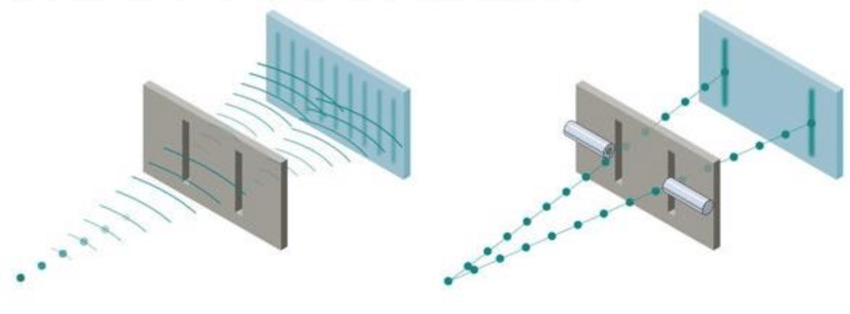
The double slit experiment was another one. What it showed, in the classic setup, was that when researchers shone a light through a “wall” with two slits in it, what appeared on the opposite wall was something indicative of the light being like waves.
But when researchers installed a detector to observe how exactly the “particles” were able to move through both slits at the same time, that same wave-like pattern disappeared.
It went something like this:
Strange, huh?
This experiment showed that the presence of the detector, sometimes called an observer, somehow changed how the photons “behaved” — with that “observer” referring to any physical interaction, not necessarily a conscious witness.
People have tried to make sense of the findings from these two sets of experiments in all sorts of different ways.
Simulation theory is just one of them — originally put forward by Nick Bostrom in 2002 as a statistical argument. In more recent discourse, people have used it as an interpretation for those quantum mechanics research outcomes.
As I continued down the rabbit hole, what stood out to me most was how some of the theory’s proponents described our universe through the logic of video games. Only when someone moves into a jungle does the jungle then become rendered; only when someone digs a hole does the underworld become realized. This is apparently for the system to save on computational power — since that’s how video games work.
Those who hold this interpretation tend to see realism as the principle that fails — if not both principles altogether.
There are other lines of reasoning that they’ve pointed to, like how humans have been able to create computerized simulations, and those inside the simulations can create simulations that mirror theirs in return, and so on — creating a chain. Therefore, they say, the probability of us being in a simulated world becomes much greater than us living in “base reality.”
The rabbit hole kept going.
But I had to take a breath.
Reminded suddenly of my own fatigued eyes, my unfiltered reaction was — I think we all need to go touch some grass!
Aren’t the digital simulations that people have created so far technically representations of simulations? And doesn’t that distinction matter?
As I thought about this more, I realized that this is not just about semantics.
Or rather, semantics actually matter a great deal when they’ve been quietly escalated from abstraction into existential conclusions about reality itself.
Once I started to pay attention to this, I noticed that this sort of slippage runs rampant in popular online discourse around metaphysics — from channels with millions of viewers.
In one of those videos, the presenter declared, “I want to be clear, this is not a metaphor. This is how dimensions work.” Later, he stated, “Reality is fragile.”
There is a big difference between recognizing that the dynamic universe constantly exceeds and subverts human language, logic, and frameworks, and inferring the world itself to be unstable simply because it resists our conceptual capture.
It was all beginning to feel like a game of epistemological telephone — where people forget where they’re standing.
A game of epistemological telephone
It doesn’t surprise me that many people drawn to simulation theory come from worlds deeply shaped by game development, software engineering, and computational systems.
Coding is a language, after all, with its own logics and ways of seeing embedded within it, as any language does.
But last time I checked, it is digital infrastructures that remain bound by the laws of the Earth — energy systems, water cycles, rare earth minerals, carbon emissions — and not the Earth operating according to human-framed code.
How many examples do we have of people attempting to control the land in some way, treating it like a machine of inputs and outputs, reducing it into mathematical equations of resource accounting, and having it all backfire because the whole of the Earth has proven itself, over and over again, to be greater than the sum of its parts?
It’s like believing there is a way to substitute an apple — with all its interacting enzymes, microbes, micronutrients, the fruit itself a mini ecosystem — with synthesized vitamins, minerals, and sugar. And then looking to the set of supplements to understand the apple itself.
That reminded me of something Lakota Elder Tiokasin Ghosthorse once told me: “It’s the difference between learning about Earth and learning from Earth.
I know there’s a little thin veil there, but it makes a difference when you’re learning from Earth who is teaching you. If you’re learning about Earth, then the information is regurgitated. So we’re stuck in this programming.”
No neutral grounds, no view from nowhere
There is a lot more that I haven't looked into yet. But I do have some responses to the interpretations that I came across.
First, “local realism” as a prior baseline didn’t come out of a vacuum. It came from centuries of observation and research within Western science that seemed to hold — until it didn’t. But it never equated with reality itself — it was still a model with assumptions about how the universe worked.
So when people jump from local realism being violated to “the universe is not real,” I do wonder how much they’ve blurred the line between frameworks and reality — to mistake the former for the latter, to experience the research outcomes as an existential destabilization rather than an invitation into deeper humility.
Second, in the double slit experiment, people often frame the “unobserved” version as the superposition with indeterminate outcomes — saying that it is only through “observation” (the addition of that detector) that the range of possibilities collapses into a definite outcome.
But why was the “unobserved” double slit setup itself treated as a baseline? Wasn’t that setup already a specific context leading to a specific outcome?
Then, as I looked deeper into each additional argument behind the simulation explanation, I realized that most of them pointed toward a common denominator: a sense of human supremacy — the presupposition that humans can eventually grasp and recreate this living world.
There’s Nick Bostrom’s famous trilemma, for example, which states that we have three possibilities: either 1) civilization ends before people reach simulation capacity; 2) people choose not to simulate; or 3) we’re almost certainly in a simulation.
To him, the simulations need not be perfect replicas so long as the experience becomes indistinguishable for those within it.
Yet all these “options” rest on a hidden premise, an underlying presumption, that I’d like to drag into question: the belief that it is even in the realm of possibility for humans to simulate our living, breathing world.
The high probability calculations never began from neutral grounds. They depend on a worldview that humans can eventually recreate this whole shebang convincingly enough for the beings within it.
That belief is far from universal. It comes from… a particular cultural orientation, a particular relational context. The same is true of the architectures and languages of computer programming.
Then there’s the Mathematical Universe Hypothesis — the idea that reality is fundamentally mathematical, and therefore simulation should eventually be able to mirror base reality.
To that, I’d say, of course the universe is mathematical… in the same way it is chemical, biological, sensorial, and relational. We developed mathematics through observing aspects of reality, after all. But that doesn’t mean humans are capable of perceiving, much less encoding, how everything works and interacts.
If we cannot even learn our own lands well enough to properly care for them — wreaking havoc, driving the sixth mass extinction, poisoning our own food and waters — how do we expect to answer any larger-than-life question at all?
Part of my growing frustration, I realized, came from how a lot of this theorizing frames the questions as mathematical, when much deeper assumptions about reality need to be examined first.
So let me circle back.
If they say that reality only becomes realized in the presence of the observer, I would just add that in my view, that observer includes everybody at the same damn time — human, more-than-human, microbial, multicellular, chemical, geologic, and everything else outside of our comprehension.
To me, the growing research points toward how the whole constellation shifts in some way as soon as a new thing or being is introduced, near or far. That inside of our entangled, Earthly world, everything is contextual and relational.
This kind of worldview of entanglement is rooted in many ancient, Indigenous, and land-based epistemologies. There is also a growing realm of scientific interpretation called relational quantum mechanics, developed by theoretical physicist Carlo Rovelli, that arrives at similar conclusions through physics.
As Rovelli writes in Helgoland:
“If the strangeness of quantum theory confuses us, it also opens new perspectives with which to understand reality. A reality that is more subtle than the simplistic materialism of particles in space. A reality made up of relations rather than objects.”
Loosening the compacted soils of our knowing
What else might this all mean?
The way I see it is that these experiments destabilize how modern Western science gauges credibility in the first place — primarily through assessing the repeatability and generalizability of outcomes.
We’ve learned so much from researchers who have committed their lives to reiterating knowledge within their fields of inquiry. I am deeply drawn to that kind of life-long curiosity.
Still, the larger architecture around knowledge production was never neutral.
On top of the institutional biases in research funding, these gold standards of credibility have been structurally skewed toward universalizable findings — and against context-dependent knowledge.
Disciplines grounded in whole systems thinking, such as ecology and complexity science, already center context and relationality at the heart of their inquiries.
But what if the research cutting and slicing up the Earth into the smallest pieces comes out the other side to find inseparability as universal?
Philosophers of science have been raising inquiries like this for decades. And many researchers who I’ve interviewed have also challenged their own fields in similar ways.
I’m thinking about Dr. Manulani Aluli Meyer’s remark from our conversation: “Specificity leads to universality, not the other way around.”
While these perspectives are not new, they have often been shoved into the margins. After all, they unsettle logics of reductionism, commodification, and extraction — which depend on separability rather than situated relationality as a principle of life.
They also reorient our understandings of credibility.
If people acknowledged reality to be context-dependent, I would go on to ask: Aren’t the people with the most intimate relationships to place the ones with the most calibrated lenses for understanding the Earth beneath their feet?
Where is the prize for people like the late Siekopai Elder Delfín Payaguaje, who learned to name over a thousand medicinal plants and their uses — plus how the plants, animals, and insects relate — within his specific pocket of the Amazon rainforest? Not producing one singular groundbreaking finding, but carrying a whole constellation of grounding knowledge?
I want to return for a moment to the argument that simulations need not be perfect replicas so long as they are “convincing enough” for those within them.
That, I realized, creates a moving target.
What counts as “convincing” depends largely on how deeply attuned one is to the living textures and webs of relationship around them.
It may not be especially difficult to simulate a forest for someone who experiences it only as background scenery, who thinks all bananas ripen yellow.
But I imagine it would be much harder to convince someone like Delfín.
May we go touch grass and learn their names
I’m now looking out the window toward my food garden, this mini ecosystem I’ve been co-developing while… dare I say, modeling after forest succession.
And I’m feeling this quiet tug — this reminder that the land holds many lessons while still resisting formulas. That the Earth slows me down enough to notice patterns while keeping me on my toes to witness how it continues to emerge. That our maps can be deeply informative, while still never catching up fully to a territory’s endless reconfiguration of life.
What are the intentions behind our modeling and map-making, anyway? To help us deepen our relationships to place, or as tools of objectification and imposition — to render complex ecosystems into static units for legibility, management, and subjugation?
Historically speaking, it’s been the latter.
Historically speaking, tools of abstraction have often had deadly consequences.
So maybe it’s helpful to come back down from the clouds of speculation to feel the solid ground beneath us — to look at where we actually are.
Our current reality is that humans are far from having any sort of “mastery” of the Earth.
And it is important to complicate that category of humans.
Whose cultural orientations and worldviews have cultivated more reciprocal, long-term relationships with the land, and whose have tended to cause rupture and destabilization — disrupting social fabrics, water cycles, climates, biodiversity?
There is physical evidence for this everywhere around us.
So why has ecological consequence not been central to how we gauge epistemic credibility?
I still have many more questions than answers.
But in the end, as I’m realizing — it does not matter to me whether this were some higher-level being’s stunning recreation or the “real deal.”
After all, there are people who find the simulation possibility ridiculous but move through the world as though their actions have no consequences for anyone else; and there are people who entertain the idea who are deeply committed to leaving positive imprints wherever they go.
There are people who live in the countryside whose relationship with the land is one of domination and control; and there are people who live in highly mediated cities who practice reciprocity and mutual aid as a way of life.
For me, I don’t need reasons to lower the stakes of my aliveness.
I want to retune my senses so I can better notice how my presence in any context shifts the constellations around me.
I want to deepen my participation in the agential communities I’m a part of.
And I want to keep learning how I can help make this world more loving, liberating, and beautiful for everyone who is here.
May we not just touch grass but learn their names, histories, and webs of relations.
May we feel tickled by their fluttering leaves against our bare ankles — while our warmth pulses into their stomas.
May we linger long enough to notice how they never grow quite the same way across the shifting seasons — and sense how that quiet, daily humbling might leave us forever changed.